0%

Choosing an Aluminium Sliding Window for an overseas project takes more than comparing frame prices. Buyers must weigh climate, opening size, glass specification, hardware, installation, and after-sales support. A coastal home may need corrosion-resistant finishes, while a high-rise apartment may require carefully specified safety glass and wind-load performance. Details matter.

For a transparent editorial perspective, this guide uses a fictional composite fenestration adviser, Elena Park. Her illustrative rule is: “Judge a sliding window by how it performs after years of daily use, not by its showroom appearance.” This is original wording, not a verified quotation from a real expert. The idea is practical: a smooth sample track can feel impressive, but drainage, seals, rollers, and installation quality determine everyday performance.

The seven buying tips that follow help global buyers ask better questions before requesting quotations. They cover profile strength, glass choices, weather performance, hardware, customization, supplier verification, and delivery planning. Product claims should be checked against relevant test reports and project requirements; specifications can vary by market and building design. Ask for clear drawings, written performance data, finish samples, and warranty terms. Small checks help. Still, no checklist can replace a qualified site assessment, and buyers should allow time for one.
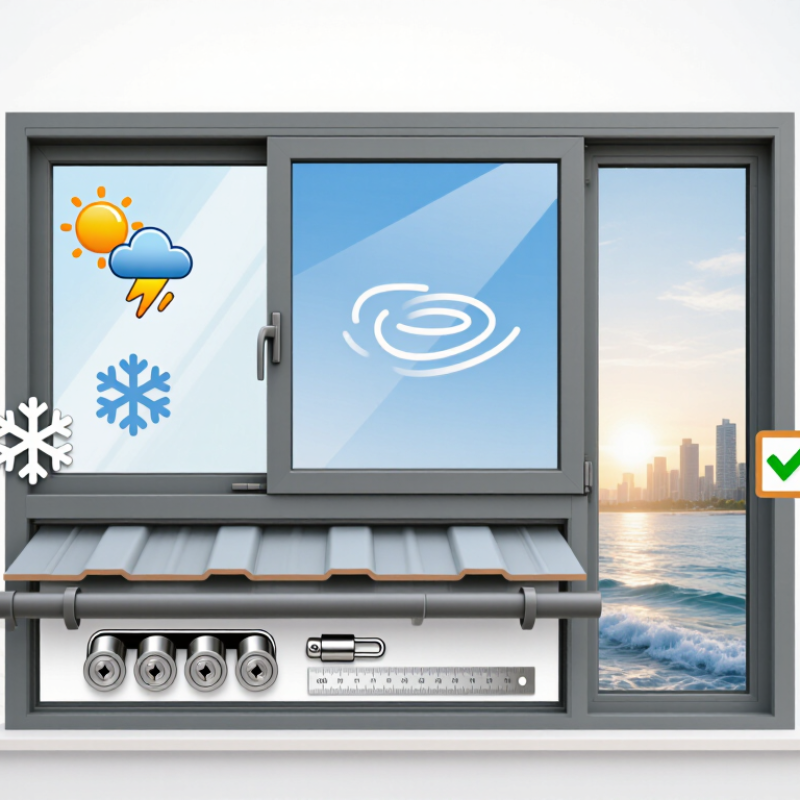
7 Aluminium Sliding Window Buying Tips for Global Buyers

Define Project Requirements and Local Climate Conditions

Before comparing aluminium sliding windows, record opening sizes, room use, orientation, and ventilation needs. Match these details to local weather records, not just a broad “hot” or “cold” label. NOAA’s 1991–2020 U.S. Climate Normals report monthly temperature and precipitation; buyers elsewhere can consult their national meteorological service. Coastal projects should also assess prevailing winds and salt exposure. Small details matter. A west-facing living room may need different solar control from a shaded bedroom.

Climate classifications help screen options. ASHRAE Standard 169 groups locations by temperature and moisture, but it cannot replace a site review. The U.S. Department of Energy estimates that windows account for 25–30% of residential heating and cooling energy use. Ask for whole-window U-factor and solar heat gain coefficient (SHGC), not glass-only figures. Check air leakage and water resistance against project specifications, too. In humid or coastal areas, inspect drainage paths, hardware materials, and finish durability. I would revisit the assumptions after checking elevation and nearby buildings; wind exposure is easy to underestimate.

Compare Aluminium Frame, Glazing, and Hardware Options

7 Aluminium Sliding Window Buying Tips for Global Buyers

Compare Aluminium Frame, Glazing, and Hardware Options

Compare frame sections by more than appearance. Aluminium conducts heat readily, so ask whether the frame includes a continuous thermal break. Check the cross-section: a narrow gap or poorly joined barrier may weaken thermal performance. The U.S. Department of Energy’s Energy Saver guidance estimates that windows account for 25–30% of residential heating and cooling energy use. That makes frame design worth checking, not just frame color.

For glazing, compare U-factor and solar heat gain coefficient (SHGC), rather than relying on terms such as “double glazed.” The National Fenestration Rating Council’s ratings provide standardized values for these measures, making product comparisons more meaningful. Lower U-factor generally limits heat transfer; suitable SHGC depends on climate, orientation, and shading. A sunny western façade may need a different balance than a shaded northern one. There is no universal best glass.

Hardware deserves a hands-on check. Slide the sash across its full track, then test the lock with the window closed. Look for smooth rollers, replaceable components, and corrosion-resistant finishes, especially near coastal air. Ask the supplier for documented cycle and corrosion test results. A polished handle proves little. I would also inspect drainage paths and seals, though these details are easy to overlook when comparing quotations. A small sample may not reveal installation problems.

Check Energy, Safety, and Regional Compliance Standards

Energy performance depends on the whole window, not just the aluminium frame. Ask for tested whole-window U-factor and solar heat-gain data, then compare them with your local climate. In hot, sunny locations, lower solar gain may reduce afternoon heat; colder regions often need stronger insulation. Numbers matter. Published values can differ by glass size and test method, so request the report for the exact configuration.

Safety deserves equal attention. Check whether the glass is safety-rated for its location, especially near doors, low sills, or busy walkways. Laminated glazing can stay bonded after cracking; tempered glass breaks differently, and local rules shape the suitable choice. Test the handle and lock in person: a stiff latch or loose meeting rail is easy to overlook in a catalogue. Small details count.

Regional compliance is not a single global checklist. Ask the supplier for current test reports covering air leakage, water penetration, wind pressure, and required thermal performance. Confirm the reports match the frame depth, glass, hardware, and installation method you plan to buy. A strong laboratory rating can disappoint if site drainage or fixing is poor. Leave time for local review; it can feel slow, but guessing is costlier.

7 Aluminium Sliding Window Buying Tips for Global Buyers — Check Energy, Safety, and Regional Compliance Standards

# Buying Tip What to Check Useful Standards or Regional References Evidence to Request
1 Compare whole-window energy performance Check the tested or certified U-factor and, where applicable, solar heat gain coefficient (SHGC). Compare the complete window assembly—not just the glass—and confirm the values suit the local climate and project requirements. United States: NFRC ratings are commonly used for certified product energy data. Canada: energy-code requirements vary by jurisdiction; applicable product ratings and code provisions should be confirmed locally. Europe: check the project’s national energy rules and declared product performance. A current rating or test report for the specified window configuration, including frame, glazing, dimensions, and hardware.
2 Check thermal-break and glazing details Ask whether the aluminium frame incorporates a thermal break and review the glazing build-up, spacer, seals, and condensation-control details. Performance depends on the complete window design and installation. Relevant requirements depend on the destination country and building type. In Europe, product performance is commonly declared under the applicable window-product framework; national energy rules set project requirements. Section drawings, glazing specifications, and thermal-performance documentation for the proposed configuration.
3 Verify air, water, and structural performance Confirm tested air leakage, water penetration resistance, and resistance to wind loads. Match test pressure and performance class to the building height, exposure, local climate, and installation conditions. North America: NAFS is used in applicable jurisdictions, with adoption and requirements varying by location. Australia: AS 2047 covers windows and external glazed doors in its scope. Europe: check declared performance and applicable national requirements. Test reports for the same product series and a configuration representative of the required size, glazing, and hardware.
4 Choose safety glass for the location Determine whether safety glazing is required near doors, in low-level glazing, or in other impact-risk locations. Confirm whether tempered or laminated glass is appropriate; the two types have different breakage behavior. Requirements vary by jurisdiction and installation location. Examples include ANSI Z97.1 in the United States and EN 12150 for thermally toughened soda-lime silicate safety glass in Europe; local building rules determine where safety glazing is required. Glass type, thickness, safety markings, and product certificates or test documentation required by the destination market.
5 Review locks, restrictors, and fall protection Check lock engagement, operating hardware, child-safety needs, and any restrictors or screens specified for the project. A window lock or screen should not be assumed to provide fall protection unless it has been designed and approved for that purpose. Building and safety rules for guarding, opening limits, and emergency escape vary by country and building use. Confirm requirements with the local building authority or project designer. Hardware schedules, operating instructions, security or restrictor test evidence where required, and details showing how the window meets the project’s safety requirements.
6 Match finish and corrosion protection to the exposure Specify a suitable coating or anodized finish for the local environment, especially in coastal, industrial, or high-humidity locations. Ask about pretreatment, coating thickness, maintenance, and warranty conditions. Coating specifications such as AAMA 2604 or AAMA 2605 may be referenced in North American projects. Applicability and required performance depend on the project specification; salt-spray test results alone do not establish service life. Finish specification, relevant test or certification documents, color samples, care instructions, and written warranty terms.
7 Confirm regional compliance and installation requirements Check that the exact product is permitted for the destination market and that labels, declarations, test evidence, and installation details meet local rules. Confirm drainage, flashing, anchorage, and perimeter sealing are appropriate for the building envelope. Examples include applicable building codes and NAFS provisions in North America, AS 2047 in Australia, and the relevant product and national building requirements in European markets. Requirements and market-transition rules can change. A compliance document set for the destination country, plus project-specific installation instructions and confirmation from the local designer, certifier, or authority where needed.

Note: Standards, code editions, and adoption rules differ by country and may change. Verify the current requirements for the project location before ordering.

Evaluate Suppliers, Product Quality, and Warranty Terms

7 Aluminium Sliding Window Buying Tips for Global Buyers

Supplier evaluation should begin with traceable evidence, not polished catalogues. Ask for the exact alloy, temper, frame-wall thickness, and hardware specification for the quoted model. Then compare those details with a production sample and independent test reports. A sample can look excellent while the delivered frame differs. Check that report numbers and product dimensions match your order. The U.S. Department of Energy’s Energy Saver guidance estimates that windows account for 25–30% of residential heating and cooling energy use. That makes verified thermal ratings worth checking. Review U-factor and solar heat gain coefficient values, and confirm the tested configuration includes the glass and seals you plan to buy.

Warranty wording deserves equal attention. Request separate coverage periods for frames, powder coating, rollers, locks, and insulated glass. Check exclusions for coastal exposure, cleaning chemicals, installation errors, and normal finish fading. Small print matters. Ask who pays freight for replacement parts, how claims are documented, and whether spare rollers remain available after several years. A long warranty can still be thin. Compare the written remedy, not just the number of years. The National Fenestration Rating Council explains how certified product labels report energy-performance ratings; ask suppliers for matching certification records. Keep the quotation, drawings, test reports, and warranty schedule together. One detail buyers sometimes miss: get the warranty in the language used by the purchasing team, not only the factory’s standard version.

Plan Shipping, Installation, and Long-Term Maintenance

For global buyers, plan shipping around the complete packed unit, not just the window frame. Confirm crate dimensions, total weight, glass protection, and unloading requirements before booking freight. A narrow doorway or missing forklift can turn delivery day into an expensive delay. Ask how each panel is secured and whether the crate can be stored under cover if installation is postponed. Build in time for transit changes and inspection on arrival. Small details matter. Check the shipment promptly for cracked glass, bent tracks, or missing hardware, and photograph any damage before moving the crate.

Installation conditions affect how smoothly an aluminium sliding window operates. Give the installer the opening dimensions and wall details in advance, and have the opening checked for level and square. Even a small deviation can cause stiff movement or uneven gaps. Confirm how the sill will drain water and how the frame will be sealed to the surrounding wall. It is easy to focus on the frame and overlook drainage; that deserves a second look. For long-term care, keep tracks free of grit and rinse salt deposits in coastal areas. Use a soft cloth and mild cleaner, then check rollers, seals, and drainage slots periodically. Maintenance needs vary with exposure, so follow the product’s care guidance rather than assuming one schedule fits every site.

FAQS

What project details should I record before comparing aluminium sliding windows?

Measure each opening and note room use, orientation, and ventilation needs. A west-facing living room may need more solar control than a shaded bedroom.

How should I assess local climate conditions?

Check monthly temperature and precipitation records, then consider wind exposure, elevation, nearby buildings, and salt air. A broad “hot” or “cold” label is not enough.

Which performance figures should I request?

Ask for whole-window U-factor and solar heat gain coefficient, not glass-only figures. Also check air leakage and water resistance against your project requirements. Small numbers matter.

Can a climate classification replace a site review?

No. It can help screen options, but it may miss local wind or moisture conditions. I would double-check assumptions around exposed elevations.

How can I verify a supplier’s product details?

Request the alloy, temper, frame-wall thickness, and hardware specifications. Compare them with a production sample and test reports for the exact model and dimensions.

What should I check in the warranty?

Request separate coverage periods for frames, coatings, rollers, locks, and insulated glass. Review exclusions, claim evidence, replacement-part freight, and future spare-part availability.

What extra checks matter in coastal or humid locations?

Inspect drainage paths, hardware materials, and finish durability. Confirm whether salt exposure or specific cleaning chemicals affect warranty coverage.

What documents should I keep with my order?

Keep the quotation, drawings, matching test reports, certification records, and warranty schedule together. Get the warranty in your purchasing team’s working language. Easy to miss.

Conclusion

Choosing an Aluminium Sliding Window for an international project starts with clear requirements. Consider the opening size, intended use, local climate, exposure to wind or moisture, and the level of ventilation and natural light needed. Compare frame strength and finish, glazing types, seals, rollers, and locks to find a configuration suited to the building and its expected performance. Check that the selected product meets applicable energy-efficiency, safety, and regional building requirements, and confirm that specifications are documented.

Before purchasing, assess suppliers by reviewing product details, quality-control practices, communication, and warranty coverage. Clarify what the warranty includes and how service or replacement parts will be handled. Also plan packaging, shipping schedules, site measurements, installation responsibilities, and access for future cleaning and maintenance. Taking these steps helps buyers make a practical, well-informed choice and reduces the risk of delays or mismatches between the window, the project, and local conditions.

Amelia

Amelia

Amelia is a professional marketing specialist with a strong understanding of product strategy, customer needs, and digital communication. As a key contributor to the company’s content team, she regularly updates the corporate website with practical, well-researched blog articles that help readers......