China Top Aluminum Bathroom Door Manufacturers?
Table of Contents
- China’s Aluminum Bathroom Door Market: 6063-T5 Profiles and Industry Standards
- How to Evaluate Manufacturers Using GB/T 8478, ISO 9227, and AAMA 2604
- Key Product Metrics: 1.2–2.0 mm Profiles, Coating Thickness, and Hardware
- Leading Chinese Manufacturer Profiles: Certifications, Capacity, and Export Records
- Factory Sourcing Criteria: MOQ, Lead Time, Warranty, and Quality-Control Data
- FAQS
- Conclusion
- Related Posts
China has become a major manufacturing base for architectural aluminum products, including bathroom doors. The International Aluminium Institute identifies construction as one of aluminum’s largest global end-use sectors. Grand View Research also reports continued demand for aluminum in building applications because of its low weight, corrosion resistance, and design flexibility. These trends create strong opportunities for buyers seeking an Aluminum Bathroom Door from Chinese suppliers.
However, factory scale does not automatically prove product reliability. A dependable manufacturer should show clear alloy specifications, coating information, hardware details, and repeatable quality-control records. For bathroom applications, buyers should examine water exposure, surface oxidation, seal performance, hinge durability, and dimensional accuracy. Small details matter. A door that closes unevenly can quickly damage seals and frustrate users.
This guide evaluates China’s leading manufacturers through practical and verifiable criteria. These include production experience, export capability, material traceability, testing procedures, customization support, and after-sales communication. Certifications can strengthen confidence, but they should not replace independent checks. ISO 9001 certification, for example, describes a management system rather than guaranteeing every finished door.
Some rankings remain subjective. A supplier with excellent engineering may have weaker communication. Another may offer attractive prices but limited testing evidence. That is why catalogs deserve careful questioning. Product samples, factory audits, and documented inspection reports provide stronger evidence than promotional claims. The best choice depends on project location, bathroom humidity, installation conditions, budget, and required design life. Content from company websites should also be cross-checked with recognized standards and buyer feedback.
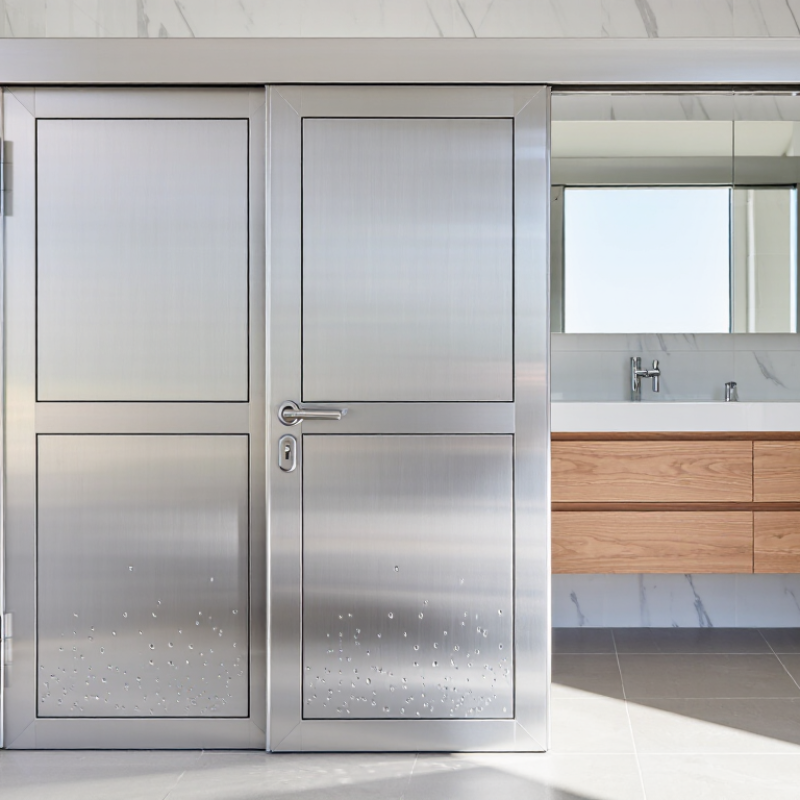
China’s Aluminum Bathroom Door Market: 6063-T5 Profiles and Industry Standards
China’s aluminum bathroom door market is built around practical extrusion, not decoration alone. International Aluminium Institute data recorded about 41.5 million tonnes of primary aluminum production in China in 2023. This large supply base supports steady access to 6063 alloy profiles, commonly selected for bathroom doors because they offer good extrudability, corrosion resistance, and surface finishing performance.
The T5 temper matters. It indicates artificial aging after extrusion, helping the profile retain useful strength and dimensional stability. However, “6063-T5” is not a complete quality guarantee. GB/T 5237.1 specifies requirements for aluminum alloy extrusion profiles, while GB/T 5237.2 addresses anodized finishes. For doors and windows, GB/T 8478 also provides relevant technical guidance.
Buyers should check alloy designation, wall thickness, straightness, hardness, and coating thickness in the inspection report.
Moisture exposes weak details quickly. A thin corner, uneven anodizing, or poorly sealed screw hole may develop stains within months. Factory experience suggests checking profile cut surfaces, drainage paths, hinge reinforcement, and gasket compression before approving samples. This step is often skipped. It should not be.
Industry data helps, but site conditions still change the result. Coastal bathrooms need stronger corrosion controls than dry inland apartments. Some specifications remain vague, and that is a real sourcing risk. A reliable supplier should provide traceable material certificates, batch records, and test results rather than relying on polished samples.
How to Evaluate Manufacturers Using GB/T 8478, ISO 9227, and AAMA 2604
China Top Aluminum Bathroom Door Manufacturers?
A reliable supplier should prove performance, not only display polished samples. GB/T 8478 evaluates aluminum doors and windows through air tightness, water tightness, wind resistance, and related requirements. Ask for the exact tested configuration, profile series, glass type, hardware, and installation method. A report for another product is weak evidence. Check the laboratory’s accreditation and report validity.
ISO 9227 is useful for comparing corrosion resistance through neutral salt spray testing. However, it does not define one universal acceptance level. This matters. Ask how many hours were tested, whether blistering or corrosion appeared, and how adhesion was checked afterward. AAMA 2604 adds a higher coating-performance reference, including color retention, chalking, adhesion, and weathering resistance. Request coating thickness records and production batch traceability. A glossy showroom sample can mislead.
The 2024 Global Status Report for Buildings and Construction reports that buildings consume about 32% of global energy and produce roughly 34% of global carbon emissions. Durable, well-sealed bathroom doors can support lower replacement and maintenance demands, although they cannot solve building energy loss alone. I would also inspect corner joints, drainage holes, seals, and hinge alignment on a working sample. Ask the manufacturer to repeat testing after assembly. Standards help, but installation remains an uncomfortable variable.
China Top Aluminum Bathroom Door Manufacturers? How to Evaluate Manufacturers Using GB/T 8478, ISO 9227, and AAMA 2604
ISO 9227 chamber temperatures shown below are standardized reference conditions. Use them together with GB/T 8478 product-performance records and AAMA 2604 coating qualification evidence when comparing aluminum bathroom door manufacturers.
Check the manufacturer's test records for aluminum alloy door and window performance, including air tightness, water tightness, wind pressure resistance, and applicable physical requirements.
Verify whether the corrosion test used neutral salt spray, acetic acid salt spray, or copper-accelerated acetic acid salt spray, and request the exposure duration and failure criteria.
Request coating-system documentation showing high-performance organic coating compliance, pretreatment details, film thickness, color retention, chalk resistance, and exterior exposure evidence.
The chart displays ISO 9227 chamber temperatures: NSS and AASS at 35°C, and CASS at 50°C. ISO 9227 does not set one universal exposure duration for every product; the duration and acceptance criteria must be specified in the test plan.
Key Product Metrics: 1.2–2.0 mm Profiles, Coating Thickness, and Hardware
China Top Aluminum Bathroom Door Manufacturers?
When evaluating aluminum bathroom door manufacturers in China, profile thickness deserves close attention. A 1.2 mm profile can suit lightweight interior doors, but it may feel flexible under repeated use. Profiles around 1.6–2.0 mm usually provide better rigidity and screw retention. However, thicker is not automatically better. Poor alloy quality or weak corner joints can still create movement.
Ask manufacturers for alloy details, dimensional tolerances, and production samples. Measure the profile with a calibrated micrometer, not visual judgment. Small deviations can affect door alignment. Coating thickness also needs a clear target, usually stated in microns. Request the coating type, surface preparation method, and test standard. Check several points on the frame, including corners and hidden edges. Those areas often receive less attention.
Hardware should match the door weight and bathroom environment. Hinges, handles, rollers, and screws need corrosion-resistant materials or suitable protective finishes. Test the assembled door through repeated opening cycles. Listen for scraping, loose handles, or uneven closing. Factory inspection records are useful, but independent checks add confidence. In my experience, suppliers sometimes report average coating thickness rather than the lowest reading. That difference matters. No measurement is perfect. A careful buyer should record results, question inconsistencies, and compare the sample with the final shipment.
Leading Chinese Manufacturer Profiles: Certifications, Capacity, and Export Records
China Top Aluminum Bathroom Door Manufacturers?
Leading Chinese manufacturers often differ in certification depth, production control, and export experience. Strong profiles usually show valid ISO 9001 systems, environmental certifications, and tested hardware or glass documentation. Buyers should check certificate numbers, issuing bodies, and expiry dates.
A factory with extrusion, cutting, powder coating, assembly, and inspection under one roof may provide steadier quality. Monthly capacity matters, but reported figures can be optimistic. Ask for recent production schedules and sample records.
Export records reveal practical reliability. Review shipment history, destination markets, container frequency, and repeat-order evidence. A manufacturer serving different climates should explain corrosion protection, sealing methods, and packaging details.
Look for carton labels, moisture barriers, corner protection, and replacement-part procedures. These small details often predict fewer installation problems.
Still, no profile is perfect. Some companies present impressive facilities while outsourcing critical finishing work. That is not automatically wrong, but it requires disclosure and inspection. An independent pre-shipment check can confirm dimensions, surface consistency, glass safety markings, and hardware operation before payment.
Factory Sourcing Criteria: MOQ, Lead Time, Warranty, and Quality-Control Data
China Top Aluminum Bathroom Door Manufacturers?
A serious factory should disclose MOQ by product type, not hide it in a quotation. Standard doors may start at 50–100 sets, while custom finishes often require 200–500 sets. Confirm whether MOQ includes packaging, spare parts, and replacement panels. Lead times should separate sample approval from mass production. A realistic benchmark is 20–30 working days after deposit and confirmed drawings. Shorter promises need evidence.
Material scale does not guarantee product quality. The U.S. Geological Survey estimated global aluminum smelter output at about 70 million metric tons in 2023. However, bathroom doors depend on alloy control, extrusion accuracy, coating adhesion, and hardware alignment. Request mill certificates, profile dimensions, coating-thickness readings, and door-cycle records. A useful factory file includes batch numbers and dated inspection photographs. ISO 2859-1 can guide sampling, but it does not replace process control.
Warranty terms deserve careful reading. A two-year warranty may exclude corrosion, hardware wear, or installation errors. Ask for a clear claims process, response time, and available spare parts. For private-label projects, three to five years is a stronger commercial benchmark. Require inspection before shipment, including opening tests, diagonal measurements, seal checks, and surface review. Independent testing adds confidence. Still, paperwork can look perfect while a poorly packed corner arrives damaged. That weakness should remain visible in the sourcing decision.
FAQS
It extrudes easily and resists moisture-related corrosion. The T5 temper adds useful strength and dimensional stability. It also accepts anodized or painted finishes well. Still, the alloy code alone proves little.
Check alloy designation, wall thickness, straightness, hardness, and coating thickness. Inspect the cut edge for voids, roughness, or uneven metal. Thin corners may weaken after repeated use. This detail is easy to miss.
GB/T 5237.1 covers aluminum extrusion profile requirements. GB/T 5237.2 addresses anodized surface finishes. GB/T 8478 relates to door and window performance. ISO 9227 supports corrosion comparison through salt spray testing. AAMA 2604 provides a stronger coating-performance reference.
Confirm the tested profile series, glass type, hardware, and installation method. A report for another configuration is weak evidence. Check laboratory accreditation and report validity. Ask for air-tightness, water-tightness, and wind-resistance results. Paperwork can still hide gaps.
Inspect drainage paths, screw holes, corner joints, and gasket compression. Look for uneven anodizing or coating damage. Coastal projects need stronger corrosion controls than dry inland locations. Ask about salt spray hours, blistering, corrosion, and adhesion results. A shiny sample may mislead.
Request material certificates, batch records, profile measurements, and coating readings. Door-cycle records can show hardware durability. Dated inspection photographs improve traceability. Sampling may follow ISO 2859-1 guidance. Sampling is not process control.
Standard doors may require about 50–100 sets. Custom finishes may require roughly 200–500 sets. Confirm whether packaging, spare parts, and replacement panels count toward MOQ. A practical production benchmark is 20–30 working days after approval. Shorter promises need evidence.
Require pre-shipment checks for opening, diagonals, seals, surfaces, and packaging. Test a fully assembled door, not only loose profiles. Clarify corrosion exclusions, hardware wear, installation errors, and response times. Ask about spare-part availability and claim procedures. A perfect file cannot protect a crushed corner.
Conclusion
China’s aluminum bathroom door market is built around durable 6063-T5 aluminum profiles, practical designs, and increasingly standardized production. When evaluating suppliers, buyers should review compliance with GB/T 8478, corrosion-resistance testing such as ISO 9227, and coating performance aligned with AAMA 2604. Important product metrics include profile thickness, typically 1.2–2.0 mm, coating thickness and consistency, sealing performance, glass compatibility, and the quality of hinges, handles, rollers, and other hardware.
A reliable manufacturer should provide clear certifications, stable production capacity, documented export experience, and traceable quality-control records. Factory selection should also consider minimum order quantity, production lead time, packaging standards, warranty coverage, inspection procedures, and after-sales support. Comparing these factors allows importers, distributors, and project buyers to identify an Aluminum Bathroom Door supplier that offers consistent quality, dependable delivery, and long-term value for residential and commercial applications.

Blog Tags: