High-Performance Aluminum & Clad Fenestration Systems
Explore our export-ready, CE-compliant casement windows, swing doors, and thermal-break entrance systems manufactured to precise architectural specifications.
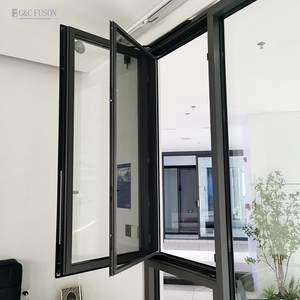
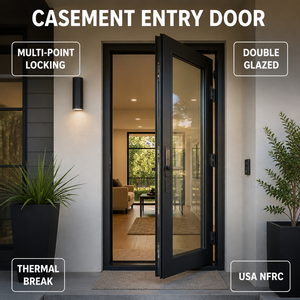
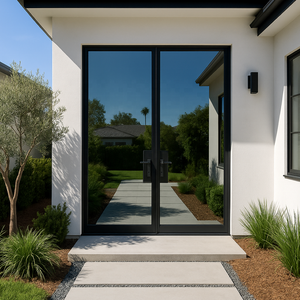
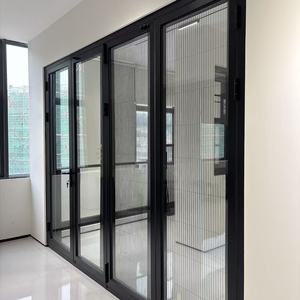
Architectural Engineering of CE Certified Aluminum Clad Casement Windows
Modern architectural developments demand fenestration systems that reconcile two inherently conflicting parameters: zero-maintenance structural longevity on the exterior envelope, and organic aesthetic warmth with superior thermal resistance on the interior facade. Standard single-material frames—such as unreinforced uPVC or uninsulated aluminum extrusions—frequently fail to satisfy stringently enforced carbon-neutral building codes such as Germany's Gebäudeenergiegesetz (GEG), North America's NFRC/ENERGY STAR 7.0, or Australia's NCC Section J.
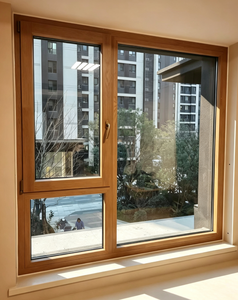
As a leading CE Certified Aluminum Clad Casement Windows Manufacturer and Exporter based in Foshan, Guangdong, ZENIC Window & Door Technology Co., Ltd. integrates state-of-the-art European extrusion mechanics with precision timber joinery. Aluminum clad casement systems combine an exterior shell of extruded 6063-T5 aluminum alloy with an interior core of solid engineered timber (such as Larch, Oak, or Pine), isolated structural polyamide (PA66-GF25) thermal breaks, and continuous EPDM weatherstripping.
Information Gain Insight: Unlike standard aluminum windows with superficial timber coatings, true aluminum-clad timber casement systems utilize floating clip fasteners that accommodate differential thermal expansion rates between metal ($\alpha \approx 23 \times 10^{-6}/\text{K}$) and wood ($\alpha \approx 5 \times 10^{-6}/\text{K}$), eliminating structural distortion across extreme temperature gradients ($-30^\circ\text{C}$ to $+70^\circ\text{C}$).
Structural Anatomy of an Export-Grade Aluminum Clad Casement Window
Understanding the inner mechanics of high-performance fenestration is essential for project specifiers, structural engineers, and commercial B2B procurement teams. Below is the multi-layer composition engineered inside ZENIC’s factory:
- Exterior Protective Shield: 1.8mm to 2.2mm wall-thickness extruded 6063-T5 aluminum alloy profile finished with AkzoNobel Interpon PVDF fluorocarbon coatings or Qualicoat Class 2 powder finishes, offering resistance to UV degradation, salt spray corrosion (ASTM B117 > 3,000 hours), and impact.
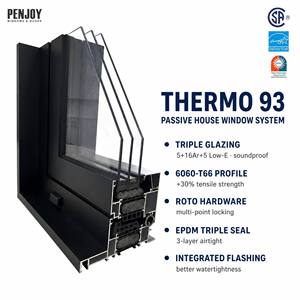
- Structural Polyamide Thermal Barrier: Multi-chambered PA66-GF25 (25% glass fiber reinforced polyamide) thermal break strips spanning widths from 24mm to 39mm, interrupting conductive heat pathways between exterior aluminum and interior timber.
- Interior Solid Timber Core: Finger-jointed, multi-laminated, kiln-dried timber (moisture content regulated between 10–12%) treated with eco-friendly water-based anti-fungal and anti-termite primers. Provides natural warmth and exceptionally low thermal conductivity ($k \approx 0.13 \text{ W/mK}$).
- Quadruple Sealing Matrix: Integrated triple-to-quadruple continuous EPDM (Ethylene Propylene Diene Monomer) gasket loops combined with dual silicone foam weather seals, securing air permeability to EN 12207 Class 4 standards.
- Insulated Glass Units (IGU): Double or triple-glazed units featuring Argon gas fill (90%+ purity), warm-edge Swiss spacers (Swisspacer Ultimate), and dual Low-Emissivity (Low-E) soft coatings, achieving center-of-glass thermal transmittance ($U_g$) down to $0.5 \text{ W/m²K}$.
CE Standard Testing Matrix (EN 14351-1 Compliance)
European Union directives mandate strict performance verification for fenestration products imported into the European Economic Area (EEA). The table below outlines the audited physical and structural metrics of ZENIC’s CE-certified aluminum clad casement window series:
| Performance Characteristic | Test Standard | Achieved Standard / Classification | CE Compliance Status |
|---|---|---|---|
| Thermal Transmittance ($U_w$) | EN ISO 10077-1 / EN ISO 10077-2 | Overall Window U-value: 0.85 – 1.1 W/m²K | PASSED (Passive House Ready) |
| Air Permeability | EN 12207 | Class 4 (600 Pa test pressure, < 3 m³/h·m²) | PASSED |
| Watertightness | EN 12208 | Class E900 / Class 9A (Unsheltered 900 Pa spray test) | PASSED |
| Resistance to Wind Load | EN 12210 | Class C5 / B5 (Deflection < 1/300 at 2000 Pa, P3 = 3000 Pa) | PASSED |
| Acoustic Performance ($R_w$) | EN ISO 10140-2 / EN ISO 717-1 | 42 dB – 48 dB (with Laminated Acoustic Glass) | PASSED |
| Safety Device Load Bearing | EN 14351-1 Clause 4.8 | 350 N Threshold Retaining Force | PASSED |
| Operating Forces | EN 12046-1 | Class 2 (Effortless single-handle operation < 5 N·m) | PASSED |
Why Global Procurement Partners Select ZENIC
Operating out of Foshan—the epicenter of global aluminum extrusion technology—ZENIC provides complete vertical integration from profile engineering to certified seaworthy delivery.
20,000 m² Advanced Production
Equipped with 5-axis German Elumatec CNC machining centers, automated corner-crimping machines, and digital glass glazing lines to eliminate manual fabrication tolerances.
Global Certification Suite
Certified against international structural and energy standards including EU CE (EN 14351-1), North American NFRC / AAMA, and Australian AS2047 fenestration protocols.
Custom OEM/ODM Engineering
Tailored extrusion dies, private labeling, specialized powder coating (RAL color palette matching), wood species selection, and custom hardware integration (Roto, Siegenia, HOPPE).
Rapid Production Lead Times
Efficient supply-chain scheduling enables factory dispatch starting from 15 business days following final CAD shop-drawing sign-off and deposit confirmation.
Export Seaworthy Packaging
Units are fully assembled, factory-glazed, wrapped in scratch-resistant EPE protective film, fitted with corner guards, and secured in fumigation-free solid plywood crates.
Full Technical Consultation
In-house structural engineers evaluate wind-load parameters, solar heat gain coefficient (SHGC) profiles, and thermal performance calculations for project submittals.
Future Procurement Trends for Aluminum Clad Casement Windows
As commercial developers, architectural studios, and B2B fenestration wholesalers look toward the 2025–2030 horizon, window sourcing strategies are undergoing a fundamental transformation driven by decarbonization mandates, evolving building codes, and technological integration.
1. Widespread Adoption of Triple-Glazed Passive House ($U_w \le 0.8\text{ W/m²K}$) Standards
The global shift toward zero-energy and Passive House building designs is converting triple-glazed, thermal-break aluminum clad casement windows from a luxury option into a regulatory necessity. In Europe and North America, urban planning frameworks increasingly enforce stringent thermal performance standards. Exporters capable of mass-producing aluminum clad casement systems with $U_w$ values under $0.8\text{ W/m²K}$ are capturing a larger share of high-tier municipal tenders.
2. Transition from Powder Coating to PVDF & Qualicoat Class 3 Surface Finishes
Coastal developments and high-humidity tropical zones present severe corrosive challenges. Future procurement specifications are moving away from standard architectural powder coatings toward 70% Kynar 500 / Hylar 5000 PVDF fluorocarbon coatings and Qualicoat Class 3 hyper-durable finishes. These coatings resist chalking, gloss retention loss, and chemical weathering under extreme ultraviolet exposure.
3. Integration of Smart Building Automation & Concealed Hardware
Architects are increasingly specifying micro-motorized automated chain actuators embedded within the interior sash frame, allowing casement windows to connect directly with Building Management Systems (BMS). Integrated rain and wind sensors automatically adjust sashes to preserve indoor environmental quality while maintaining clean, ultra-slim sightlines through concealed 180° concealed heavy-duty hinges.
4. Demand for Fully Documented EPDs (Environmental Product Declarations)
Scope 3 carbon footprint tracking is requiring developers to choose fenestration manufacturers that supply verified Environmental Product Declarations (EPDs). Sourcing partners prioritize factories utilizing low-carbon recycled aluminum billets smelted via hydroelectric power, together with FSC-certified timber harvested from sustainably managed forests.
Emerging Technology Trends in Clad Casement Window Manufacturing
The fenestration sector is experiencing significant material science breakthroughs that enhance structural integrity, thermal efficiency, and acoustic isolation:
Vacuum Insulated Glass (VIG) Integration
Replacing traditional gas-filled double/triple glazing with 8.3mm thin Vacuum Insulated Glass units that achieve an unprecedented center-of-glass thermal value ($U_g = 0.40 \text{ W/m²K}$) while reducing frame weight by up to 40%.
Bio-Based Polyamide Thermal Strips
Transitioning from fossil-derived PA66-GF25 to renewable castor-oil derived bio-polyamide thermal break profiles, reducing profile embodied carbon footprint by up to 50% without compromising tensile strength.
Acoustic Laminated PVB Interlayers
Combining acoustic-grade Polyvinyl Butyral (PVB) acoustic interlayers with unequal glass pane thicknesses (e.g., 6mm + 12Ar + 8.76mm Acoustic Laminate) to dampen urban traffic noise across low-frequency ranges.
Frequently Asked Questions by International Buyers
Clear, direct technical answers regarding MOQ, CE compliance, manufacturing lead times, and custom engineering support.
What specific testing documentation is provided to verify CE Certification (EN 14351-1)?
What is your Minimum Order Quantity (MOQ) and sample evaluation process?
How do aluminum clad casement windows handle differential thermal expansion?
What are the standard production lead times and FOB shipping ports?
Can ZENIC customize window finishes and hardware to match specific project designs?
Request Factory Direct Pricing & Technical CAD Submittals
Partner directly with Foshan's premier CE Certified Aluminum Clad Casement Windows Manufacturer & Exporter. Submit your architectural schedules or project elevations for a preliminary engineering review and quotation within 24 hours.