Featured Commercial Fenestration & Office Door Systems
Direct Factory Supply for Global Architects, General Contractors, and Commercial Importers
1. Executive Industry Analysis: The Evolution of Commercial Office Doors
Modern commercial architecture is undergoing a structural paradigm shift driven by acoustic optimization, thermal efficiency mandates, and flexible workplace spatial planning. As corporate spaces transition toward transparent, light-filled environments without sacrificing sound privacy or security, high-performance aluminium office door systems have emerged as the foundational standard for Grade-A office buildings, tech hubs, and corporate headquarters worldwide.
Sourcing directly from China—the world's dominant hub for precision aluminium extrusion and fabrication—offers global contractors and developers unprecedented supply chain advantages. China's integrated manufacturing ecosystem in regions such as Foshan combines high-purity raw material sourcing, automated CNC machining, advanced anodizing/powder coating, and rigorous ISO-compliant testing under single-roof manufacturing complexes. This comprehensive industry whitepaper breaks down technical engineering metrics, market trends, acoustic performance standards, and procurement strategies for wholesale aluminium office door sourcing.
2. Structural Engineering & Technical Specifications for Commercial Aluminium Doors
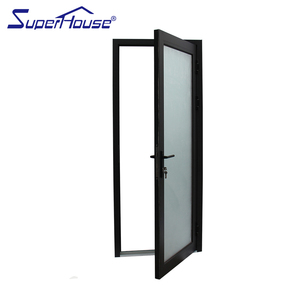
Unlike residential doors, commercial aluminium office doors operate under rigorous duty cycles requiring maximum resistance to mechanical wear, high impact, air infiltration, and acoustic leakage. Standard commercial door frames manufactured in our facility utilize prime T6063-T5 or T6063-T6 virgin aluminium alloys, ensuring optimal structural rigidity and long-term dimensional stability.
Technical Insight for Engineering Specifiers: Aluminum office doors must balance structural wall thickness with glass payload capacities. Utilizing 2.0mm to 3.0mm primary wall profile profiles ensures zero frame deflection under heavy usage, while accommodating multi-layer laminated or insulated glass units up to 42mm in thickness.
A. Acoustic Insulation Engineering (STC & Rw Ratings)
In modern corporate environments, speech privacy in executive boardrooms, legal counsel offices, and conference facilities is a critical requirement. Our acoustic-rated aluminium office door series incorporates continuous multi-point EPDM (Ethylene Propylene Diene Monomer) gasket seals combined with drop-down automatic acoustic bottom seals. When paired with double-glazed acoustic PVB (Polyvinyl Butyral) laminated glass, sound transmission class (STC) ratings reach up to 45 dB, preventing sound bleed between adjacent work zones.
B. Polyamide Thermal Break Technology
To comply with stringent international energy codes such as ASHRAE 90.1, EN ISO 10077, and Australia's NCC Section J, exterior office entryway doors incorporate high-density Polyamide (PA66GF25 with 25% glass fiber reinforcement) thermal barrier strips. These thermal breaks effectively isolate the interior aluminium extrusion from the exterior frame, mitigating thermal bridging, preventing condensation formation, and reducing HVAC thermal losses significantly.
| Performance Indicator | Standard Commercial Grade | High-Performance Acoustic Grade | Thermal Break Exterior Grade |
|---|---|---|---|
| Alloy & Temper | 6063-T5 (1.5mm - 2.0mm) | 6063-T6 (2.0mm - 2.5mm) | 6063-T5 / T6 (2.0mm - 3.0mm) |
| Acoustic Rating (Rw / STC) | 30 dB - 35 dB | 40 dB - 48 dB | 35 dB - 42 dB |
| Thermal Transmittance (U-Value) | 2.8 - 3.5 W/m²K | 2.2 - 2.8 W/m²K | 1.1 - 1.8 W/m²K |
| Glazing Capability | 8mm - 12mm Monolithic Tempered | 6mm + 1.52PVB + 6mm Laminated | 5mm + 12Ar + 5mm Low-E Double/Triple |
| Hardware Cycle Test | 100,000 Operations | 200,000 Operations | 300,000+ Heavy Duty Cycles |
| Air Infiltration & Tightness | Class 3 (EN 12207) | Class 4 (EN 12207) | Class 4 High-Sealed (EN 12207) |
3. Enterprise Manufacturing Advantages & Quality Assurance Standards
Sourcing directly from an established Foshan export manufacturer guarantees that your commercial project benefits from certified raw materials, engineered precision, and global regulatory compliance. Our 20,000 square-meter production complex integrates the entire manufacturing workflow to maintain 100% quality traceability from raw billet extrusion to final ocean packaging.
CNC Precision Machining
4-axis CNC milling and automated corner crimping ensure tolerance precision within ±0.2mm, guaranteeing seamless frame assembly on site.
Surface Finishes & Coatings
Certified Qualicoat Class 2 powder coatings, PPG PVDF finishes, and hard-anodized surface treatments tested against 3,000 hours of salt spray corrosion.
Global Code Compliance
Product configurations rigorously tested to meet NFRC, CE, AS2047, AAMA, and ISO 9001 quality management benchmarks for hassle-free site approvals.
Modular OEM / ODM Capacity
Custom profile extrusion dies, private label hardware customization, and shop drawing CAD/BIM modeling support tailored for developers and B2B buyers.
In-House Glazing & Testing
Dual-sealed insulated glass manufacturing with automated argon gas filling, structural silicone bonding, and water-tightness test bays.
Export Crate Packaging
Fully enclosed fumigation-free plywood crates lined with EPE foam buffer sheets and corner protectors to ensure zero transport damage.
4. Future Procurement Trends in Commercial Office Door Systems (2025–2030)
As commercial real estate markets adapt to hybrid work environments, smart buildings, and ESG (Environmental, Social, and Governance) investment criteria, office door procurement strategies are evolving rapidly. Global buyers must account for three major macro trends when specifying systems for upcoming architectural developments:
A. Ultra-Slim Sightline Minimalist Architecture
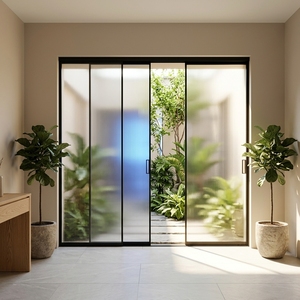
Visual transparency is now a primary aesthetic driver in modern office design. Traditional thick-frame commercial doors are being replaced by ultra-narrow frame profiles with visible sightlines under 20mm. These hidden-frame sliding and swing door systems maximize daylight harvesting, create visual continuity across open-plan floors, and elevate office interiors while retaining structural load capability through high-strength alloy engineering.
B. Smart Access Control Integration & Building Automation
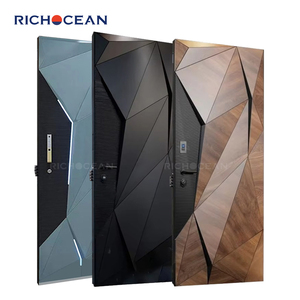
Commercial doors are no longer passive physical barriers; they are key nodes in smart building management networks. Modern aluminium office door assemblies are increasingly pre-machined during factory production to accept integrated electronic hardware: motor-driven magnetic locks, concealed biometric access readers, RFID keycard mortise locks, electric strikes, and automatic swing operators compatible with centralized IoT access systems.
C. Low-Carbon Aluminum & Sustainable ESG Lifecycle
With corporate tenants demanding LEED (Leadership in Energy and Environmental Design) and BREEAM certifications, green sourcing has shifted from a preference to a strict requirement. Leading Chinese suppliers are investing heavily in low-carbon primary aluminium smelted using renewable hydropower, closed-loop scrap recycling processes, and non-VOC water-based powder coatings. Selecting fully recyclable aluminium doors significantly lowers embedded carbon metrics in commercial building life cycle assessments.
5. Product Development & Technological Evolution in Office Fenestration
Over the past decade, technological breakthroughs in metal processing and glass technology have fundamentally transformed what is achievable with commercial aluminium doors. Key technical milestones include:
- Structural Corner Glue Injection (Pin-and-Glue Technology): Traditional mechanically screwed door corners tend to sag or gap over years of commercial use. Advanced factory assembly utilizes dual-component structural corner adhesives injected into internal alignment keys, locking corner joints permanently against water intrusion and structural sagging.
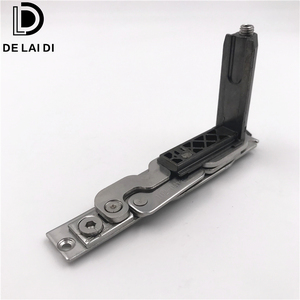
- Concealed Hardware Systems: Heavy-duty concealed hinges rated for 160kg sash weights allow clean flush surfaces without visible hardware knuckles, satisfying minimalist architectural design criteria while preventing dust buildup in high-traffic corridors.
- Vacuum Insulated Glass (VIG) Integration: The integration of next-generation ultra-thin vacuum glass into thermal break aluminium doors allows U-values as low as 0.6 W/m²K in a profile depth previously reserved for single-pane interior doors.
6. Comprehensive B2B Procurement FAQ for Global Buyers
Below are detailed solutions to common questions raised by international general contractors, architectural specifiers, and wholesale importers when procuring aluminium office doors from China:
Accelerate Your Commercial Project Sourcing
Send your door schedule, elevation drawings, or bill of quantities today. Our project engineering team will review your specifications and supply a comprehensive factory-direct quotation within 24 hours.