
Whitepaper: Industry Analysis of Top 10 Aluminum Main Door Factories & Suppliers
Modern architectural fenestration has evolved far beyond traditional timber or hollow steel entrances. In contemporary luxury residential and high-traffic commercial projects, aluminum main entrance doors stand as the primary threshold of security, thermal regulation, and aesthetic branding. As structural requirements demand wider clear spans, higher acoustic dampening, and rigorous energy efficiency, identifying qualified tier-1 aluminum main door suppliers has become a strategic priority for real estate developers, architectural specifiers, and facade contractors globally.
This whitepaper provides a comprehensive technical evaluation of leading global manufacturing hubs—with a specialized focus on the Foshan aluminum industrial cluster in Guangdong, China—analyzing material alloy grades, polyamide thermal break integration, surface finishing technologies, multi-point lock engineering, and international compliance standards including NFRC, CE, AS2047, and CSA.
Core Sourcing Evaluation Criteria for Global Procurement Directors
When auditing top 10 aluminum main door factories, procurement teams must look past superficial aesthetics and evaluate structural integrity at the raw material and component engineering levels. A high-performance aluminum main entry system relies on five foundational pillars:
- Structural Alloy Integrity: Verification of virgin 6063-T5 or 6060-T66 aluminum profiles with a minimum wall thickness of 2.0 mm to 3.0 mm for heavy-duty main entrance doors, avoiding recycled scrap alloys that compromise wind-load resistance and anodic clarity.
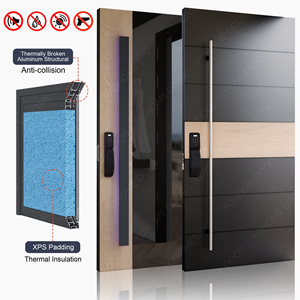
- Thermal Bridge Disruption: High-density Polyamide (PA66 GF25) thermal break strips engineered to separate exterior and interior profile profiles, reducing overall U-values down to ≤1.1 W/m²K in extreme climate zones.
- Acoustic & Weatherproofing Barrier: Co-extruded EPDM (Ethylene Propylene Diene Monomer) continuous gasket seals configured in multi-stage seal lines to achieve air permeability ratings under EN 12207 Class 4 and water tightness under EN 12208 Class 9A.
- Security & Load-Bearing Hardware: Concealed 3D adjustable heavy-duty pivot hinges and multi-point security locking gear tested to survive 200,000 continuous operation cycles without sags or latch misalignment.
- Surface Finish Longevity: Qualicoat Class 2 standard powder coating, Fluorocarbon (PVDF) 3-coat finishes, or 25-micron anodic oxidation capable of resisting high UV degradation and salt-spray corrosion in coastal architectural zones.
Comparative Technical Specifications Matrix
To assist architectural specifiers and sourcing managers, the technical matrix below outlines the baseline engineering thresholds required for export-grade aluminum main doors versus standard commercial fenestration.
| Engineering Parameter | Standard Commercial Grade | ZENIC Heavy-Duty Architectural Grade | Impact on Building Performance |
|---|---|---|---|
| Aluminum Alloy Grade | Recycled / Secondary 6063-T5 | Virgin 6063-T5 Prime Alloy | Prevents structural deflection under high wind loads; ensures uniform finish coating. |
| Profile Wall Thickness | 1.2 mm – 1.4 mm | 2.0 mm – 3.0 mm Reinforced | Supports oversized glass panels (up to 400 kg per leaf) without frame distortion. |
| Thermal Isolation | Non-Thermal Break or PVC Strip | PA66-GF25 Polyamide Strip | Cuts HVAC energy loss by up to 45%; prevents internal frame condensation. |
| Overall U-Value Range | 2.8 – 3.5 W/m²K | 1.1 – 1.6 W/m²K | Meets strict ENERGY STAR, NFRC, and European Passive House standards. |
| Sealing Technology | PVC or Rubber Strips | Triple EPDM Continuous Gaskets | Ensures high sound insulation (STC up to 42 dB) and complete water tightness. |
| Locking Mechanism | Single-Point Latch | Multi-Point Hook & Pin Lock | Reaches burglary resistance rating RC2 / RC3 / PAS 24. |
Future Sourcing & Manufacturing Trends in Aluminum Main Doors
The global door and window market is experiencing a rapid structural shift driven by architectural minimalism, stringent energy conservation directives, and smart building integration. Sourcing directors evaluating aluminum main door manufacturers over the next decade must prepare for four critical industry developments:
1. Oversized Architectural Pivot & Flush Entrance Systems
Modern luxury residential architecture increasingly replaces standard hinged doors with grand scale pivot entry doors measuring up to 2.5 meters in width and 4 meters in height. Manufacturing these massive units requires specialized internal steel or aluminum structural stiffeners, custom pivot axis hardware rated for extreme weights, and self-leveling drop-down bottom seals to maintain weather tight integrity.
2. Biometric & Smart Home IoT Access Integration
Mechanical keys are rapidly giving way to motorized smart lock systems integrated directly within the aluminum door leaf. Leading suppliers now pre-wire aluminum main doors for facial recognition scanners, fingerprint sensors, RFID keypads, and smart home automation systems (e.g., KNX, Zigbee, Control4) with backup battery modules and emergency mechanical overrides concealed within the frame profile.
3. Low-Carbon Aluminum Sourcing & EPD Certification
With environmental regulations expanding across Europe and North America, environmental product declarations (EPDs) are becoming mandatory in project submittals. Future procurement frameworks will favor aluminum door factories that utilize hydro-powered aluminum smelters, closed-loop scrap recycling, and low-carbon billets to minimize the embodied carbon footprint of the building envelope.
4. High-Performance Vacuum & Triple Insulated Glazing Units
For main doors incorporating glass panels or side-lites, triple-pane Low-E glass filled with Argon gas (or emerging Vacuum Insulated Glass - VIG) is replacing standard double glazing. This evolution allows modern glass-aluminum main doors to achieve thermal isolation equivalent to solid insulated brick walls.